Eleftherios Platis
AnalyticsAUEB03 / 06

The World Cup Crackdown

How a military junta timed its repression around the 1978 World Cup, and how I tested it with regression models.

ContextAUEB
AreaAnalytics
Tools—

01 — Abstract

As the second assignment for the Applied Machine Learning course in my BSc (2022), I replicated a 2022 American Political Science Review study by Scharpf, Gläßel and Pearce. The study asks whether autocracies change how they repress people around the international sports events they host. It focuses on Argentina's military junta and the 1978 FIFA World Cup, with two hypotheses: repression spikes in host cities in the run-up to the tournament, then drops while the world is watching. Using the authors' archival dataset of 58,383 department-day observations, I first confirmed the data by reproducing their summary-statistics tables, along with figures showing that autocracies' share of major sports events grew from about 8% in the early 1990s to about 37% today. I then estimated three nested OLS models with robust (HC1) standard errors, interacting host-city status with linear and quadratic time trends. Across all three specifications, the interaction terms were positive (0.401) and negative (−0.323) respectively, both significant at the 1% level. Together they trace a rise-and-fall curve in host cities and a flat line elsewhere. I visualised the predicted effects, extended the original figure by overlaying observed repression, and confirmed the result with two robustness checks: logit and linear probability models on a binary outcome, and a population-matched sample. The replication supports both hypotheses. The regime cracked down before the cameras arrived and eased off once they did.

02 — The problem

Autocracies are hosting more and more of the world's biggest sporting events, from about 8% of tournaments in the early 1990s to about 37% today. Supporters argue that the global spotlight pushes regimes to behave better. Critics call it "sportswashing". A 2022 study offered a sharper answer using Argentina's 1978 World Cup, hosted by a military junta: the spotlight doesn't stop repression, it changes when it happens. I wanted to test whether that finding holds up when rebuilt from the raw data.

03 — What I built

A Python replication of the study's core analysis, using pandas, statsmodels, seaborn and matplotlib:

  • Data validation: reproduced the paper's two summary-statistics tables from the archival .tab files to confirm I had the right data.
  • Context figures: the rise of autocratic hosts since 1990, and a custom event plot of every host regime across 11 international tournaments since 1947.
  • Core models: three nested OLS regressions of daily log repression events, with HC1 robust standard errors. Model 1 is the base model, Model 2 adds socioeconomic and political controls, and Model 3 adds military-zone fixed effects. The hypotheses are tested through host-city × time and host-city × time² interactions.
  • Effect visualisation: predicted repression for host and non-host cities from March to June 1978. I extended the original figure with a 5-day moving average of observed repression.
  • Robustness checks: logit and linear probability models on a binary "any repression" outcome, and a population-matched sample of host and non-host departments.

04 — What changed

The results held across every test:

  • The effect is significant and stable. Host-city × time = 0.401 and host-city × time² = −0.323 in all three models (p < 0.01). The coefficients don't move when controls and fixed effects are added.
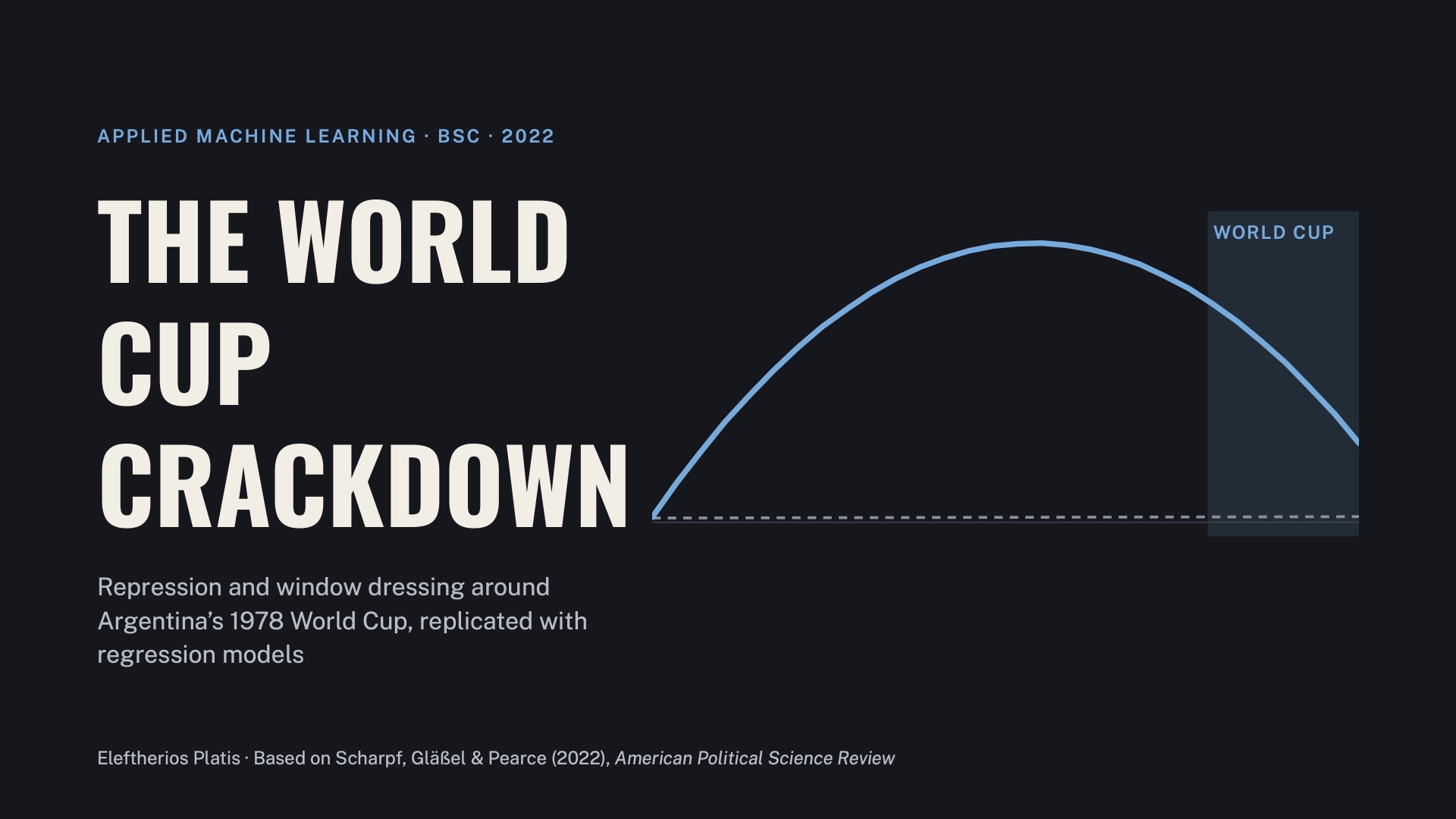
  • It's a rise and fall, only in host cities. Predicted repression climbs from near zero in March to about 0.28 daily events by early May, then falls during the tournament. Other cities stay flat throughout.
  • Real data matches the model. Observed repression in host cities follows the predicted curve.
  • It survives the stress tests. Binary-outcome models keep the same pattern, and the matched sample (4,095 observations) produces coefficients of 0.424 and −0.341. Both hypotheses are supported: the junta cleared out dissent before the world arrived and put on a cleaner face once it did. The project also showed how far you can trust a published result when you rebuild it yourself, and where your own analysis can add something new.

Presentation

The World Cup Crackdown — slide 1 of 10
01 / 10

Links

Access the Colab Notebook↗Talk to me about this project↗
← PreviousFriends Across the DivideNext →Can We Predict a Breakthrough?